

GeForce RTX on Your Laptop? What Form Will That Take and When?
By at present every self-respecting PC enthusiast and gamer will exist aware of Nvidia's new GeForce RTX twenty series graphics cards, in the RTX 2080 Ti, RTX 2080 and RTX 2070. It won't be long earlier we'll get performance numbers for these cards, too, which is heady. Simply earlier these GPUs striking the desktop, I thought it would be an interesting thought experiment to talk over what the mobile line-upwardly of these might wait like.
It's a certainty that Nvidia will bring at least some of these GPUs to gaming laptops later the desktop launch, and a few tidbits we've heard from industry sources advise information technology'll exist around Nov when nosotros hear about GeForce twenty GPUs for laptops. That's about a month later the release of the RTX 2070, which makes sense considering with the 10 serial, laptop parts were announced about ii months after the GTX 1070.

In this article I'll be breaking down the specs of the RTX cards announced so far, and giving my thoughts into how these GPUs might translate into laptop versions, what sort of specs we could come across, and what features will be kept or omitted. We practice not have any concrete information on these parts, then this isn't a rumor or leak story, we're simply speculating and opening the word into how Nvidia'due south laptop GPUs typically differ from their desktop counterparts.
No 2080 Ti
Let's starting time with the RTX 2080 Ti at the superlative stop because this one is pretty simple... It'due south very unlikely nosotros'll run into the RTX 2080 Ti in laptops but because its 250 watt TDP is too high for most laptop grade factors. When creating a laptop GPU, the power describe and TDP is the most important aspect, as laptops have much more limited cooling systems compared to what is possible in desktops. And this is particularly true when you consider that nigh gaming laptops these days are either slim and portable systems, or more than mid-tier devices, rather than massively mesomorphic beasts. And the slimmer you become, the less cooling power y'all take, which restricts the sort of GPU TDPs information technology can support.

With 10 series laptops, even the near chunky beasts topped out at fully fledged GTX 1080s, as that was the highest-end laptop GPU Nvidia provided. The GTX 1080 on the desktop had a TDP of 180W and that pushed down to around 150W for laptops, whereas the GTX 1080 Ti had a 250W TDP and at that place was no laptop equivalent. And then with the RTX 2080 Ti also packing a 250W TDP, we're certainly not going to see information technology in laptops.
RTX 2080... for chunky ones
The RTX 2080 is an interesting one. Like with the GTX 1080 in the previous generation, I expect the RTX 2080 to be the top-end GPU available in a mobile form factor, and aside from Max-Q versions which I'll talk nigh later, the fully-fledged RTX 2080 will be restricted to larger laptop designs due to its higher TDP.
The RTX 2080's TDP is a bit of an unusual example. Nvidia has listed it as 215W for the desktop, so that's up from 180W on the GTX 1080. But there's been some talk that role of this TDP is allocated for VirtualLink, the new USB-C connector spec designed for VR headsets. Supporting this connector adds effectually 30W to the graphics card's TDP requirement as VirtualLink provides power directly to the VR headset.

It remains to be seen whether Nvidia will leave VirtualLink enabled for laptop GPUs, simply I'd imagine using a VR headset with a laptop is a bit more of a niche employ case than VR with a desktop. In any example, I'd assume laptop vendors could choose not to back up VirtualLink and therefore not have to worry about the added TDP. In that case, laptops without VirtualLink could integrate an RTX 2080 and theoretically simply have to pattern a cooler for a TDP of 185W or so.
That's pretty similar to the GTX 1080's TDP of 180W, and then with further laptop optimizations we'll likely come across that drop dorsum downwardly to around the 150W mark of the 1080's laptop variant. So even though the RTX 2080 does pack a higher TDP, I fully expect information technology to make its way to laptops at effectually a 150W TDP in the cease.
Now the question becomes, what sort of specs and performance can we expect of the RTX 2080 in laptops.

Well with the GTX 1080, the laptop and desktop variants of the GPU were identical: same core configuration, aforementioned clock speeds, same memory, and provided the cooling performance was adequate, the laptop 1080 performed on par with the desktop 1080.
Nvidia seems very keen on offer laptop versions of their GPUs that are equivalent to the desktop versions -- something we totally support -- and I expect that to continue with the RTX 2080. In other words, I fully expect the laptop RTX 2080 to have 2944 CUDA cores with boost clocks in the 1710 MHz range, and utilise viii GB of GDDR6 memory.
As for real earth performance, we're still not sure how the cards will perform in the desktop, then it's hard to say for certain. But we expect the RTX 2080 to perform effectually the level of the GTX 1080 Ti, and Nvidia'southward own charts prove a thirty to twoscore percentage performance improvement over the GTX 1080 in all-time example scenarios. And then for acme-end laptops, getting a 35% performance bump or so in the aforementioned course cistron is quite a tasty proposition.

How would Nvidia manage to become this performance boost from roughly the same TDP? Well, Turing is built using TSMC's 12nm process, compared to 16nm for Pascal. That's not a huge alter, and Nvidia has called non to shrink the die on 12nm, merely instead make utilise of wider pathways. However the slight procedure improvement should bring a more favourable voltage/frequency bend, so running Turing at the same frequencies as Pascal should consume less power, at least in theory. And nosotros saw something like this in exercise with twond gen Ryzen moving from 14nm to 12nm: information technology could run at lower voltages for the aforementioned frequencies.
And so when you look at the RTX 2080 compared to the GTX 1080, boost clocks are pretty similar: 1710 MHz for the 2080, and 1733 MHz for the 1080. With Turing on 12nm, it should require less voltage to run at that frequency compared to Pascal. But then the RTX 2080 bumps upward the CUDA core count from 2560 to 2944, so it's a wider GPU at the aforementioned clocks. On paper, it looks similar Nvidia has gained some ability headroom by not increasing the clock speed of the RTX 2080, and put that towards making the GPU wider, with the end result existence similar ability consumption for the 2080 and 1080. And that's good news for laptops.
RTX 2070 Predictions
Information technology's a similar story with the RTX 2070. Nvidia lists a desktop TDP of 175W, factor in VirtualLink possibly increasing the TDP and the 2070 should pull back to around 150W, the aforementioned TDP as the desktop 1070. And once again, the laptop version of the 1070 sat around 115W, so I expect the laptop RTX 2070 to be rated for something like.

The laptop version of the 1070 was a chip of an enigma in that it was specced different to the desktop 1070 but performed around the aforementioned. The laptop variant had 2048 CUDA cores and a boost clock of 1645 MHz, compared to 1920 CUDA cores in the desktop variant with a boost clock of 1683 MHz. Nvidia could do something similar with the laptop RTX 2070, but I remember the instance of the 1070 was fairly unique and I don't wait them to follow that exact path once more.

At the aforementioned TDP, the RTX 2070 should be able to provide more performance than the GTX 1070, so once again, whatever laptops that could support the 1070'due south TDP will exist able to bump that upwardly to an RTX 2070 and get more than performance in the same form cistron. That will exist great news for mobile gamers as a lot of fairly compelling laptops were able to handle the 1070's TDP, and I think once more this will be a sweet spot for high operation gaming laptops.
How they get this extra operation is basically the same equally the RTX 2080. The RTX 2070 is clocked around the same level as the GTX 1070, but information technology includes 2304 CUDA cores compared to 2048, all thanks to the modest shift from 16nm to 12nm. On paper, that's a 12 percent performance leap, and so it's looking unlikely the 2070 will reach the level of the GTX 1080. That said, any operation increment in the aforementioned form factor is very welcome in constrained laptops.
It's trickier to predict what will happen to the tensor cores and RT cores in the laptop versions of the RTX 2080 and RTX 2070. Considering ray-tracing is the flagship characteristic of these new GPUs, I fully expect the laptop variants to support ray-tracing in some form, so that will mean these cores will need to be on the dice and active.
Whether Nvidia volition disable some tensor or RT cores to save power, I'thou not sure, though information technology would be the most obvious candidate for power savings. At the end of the day, though, ray-tracing is computationally intensive so if Nvidia really wants to promote this feature every bit being supported by their laptop GPUs, they'll probably have to keep the RT cores fully enabled. It'll be interesting to see how that pans out and what power implications it has.
I too expect Nvidia to proceed the tendency of offering Max-Q variants of the RTX 2070 and RTX 2080. I know there are plenty of people out there that dislike Max-Q as they think information technology'south some form of artificially restricting their GPU from reaching its full potential, only in reality it's actually quite a good thought for laptops and other cooling-restricted systems.

The cardinal thing Max-Q does is provide a wider range of GPUs that sit down at different TDPs. This allows a manufacturer to choose a GPU that's amend suited to their cooling solution. For instance a laptop might have more than enough thermal headroom for an RTX 2070, but not enough for an RTX 2080. Instead of capping that system to RTX 2070 performance, that system could integrate an RTX 2080 Max-Q at a TDP between the 2070 and 2080, offering meliorate performance than the 2070 but not quite at the same level as the 2080.
With the GeForce ten series, Max-Q variants of the 1080 and 1070 were clocked effectually 250 to 300 MHz lower than their fully fledged counterparts, while using the verbal aforementioned GPU with the same core configuration and memory. The clock speeds were chosen such that the GPU was operating at an optimal frequency on Pascal'south voltage/frequency curve, giving the best efficiency.
I expect something very similar with the GeForce 20 series. Nosotros'll get an RTX 2070 Max-Q clocked around 250 MHz lower that will sit between the 2070 and as-yet-unannounced 2060. And and then the RTX 2080 Max-Q will besides be clocked roughly 250 MHz to sit between the 2070 and 2080. Usually the Max-Q variants are ten% faster than the GPU below them, and 10% slower than the non-Max-Q model, but we'll look to come across how that plays out.
Every bit for pricing, we know with the desktop cards that the GeForce 20 serial is pretty expensive, with prices higher up their 10 series counterparts, and it's unlikely they volition offer as skilful value considering what we know about their performance so far. With the laptop versions, it will probably be a very similar story: better operation in the same grade cistron, simply too considerably higher prices.
An RTX 2070 laptop will likely cost at to the lowest degree $100 more than GTX 1070 laptops, and that margin will be higher for RTX 2080 laptops compared to GTX 1080 laptops.
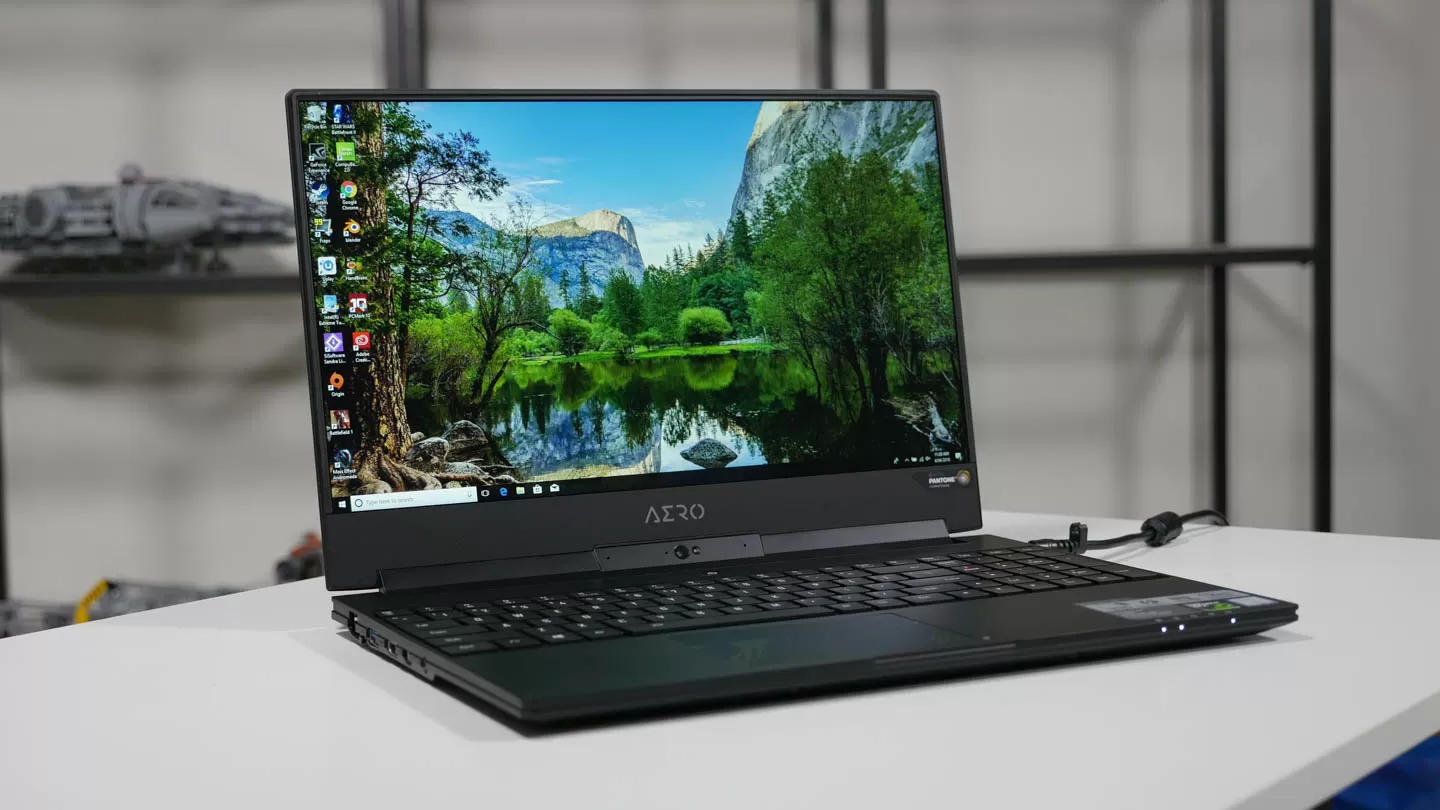
Nosotros are expecting better functioning in the aforementioned sort of designs, but for some buyers that may non justify the price increase. That said, laptops are sold as entire systems rather than as standalone GPUs, and then the value suggestion when yous compare entire system prices will end upwardly a bit more favourable than on the desktop side comparing standalone cards.
I'yard definitely excited to encounter what Nvidia does with the GeForce 20 serial in laptops and how much more performance we can get in the same form factors. I think these GPUs could offer a chip more than to laptop buyers than desktop system builders considering laptops are constrained in ways desktops are not, and any performance gains without making laptops chunkier and less portable is always welcome.

Source: https://www.techspot.com/article/1690-geforce-rtx-laptop-predictions/
Posted by: gordonworear.blogspot.com
0 Response to "GeForce RTX on Your Laptop? What Form Will That Take and When?"
Post a Comment